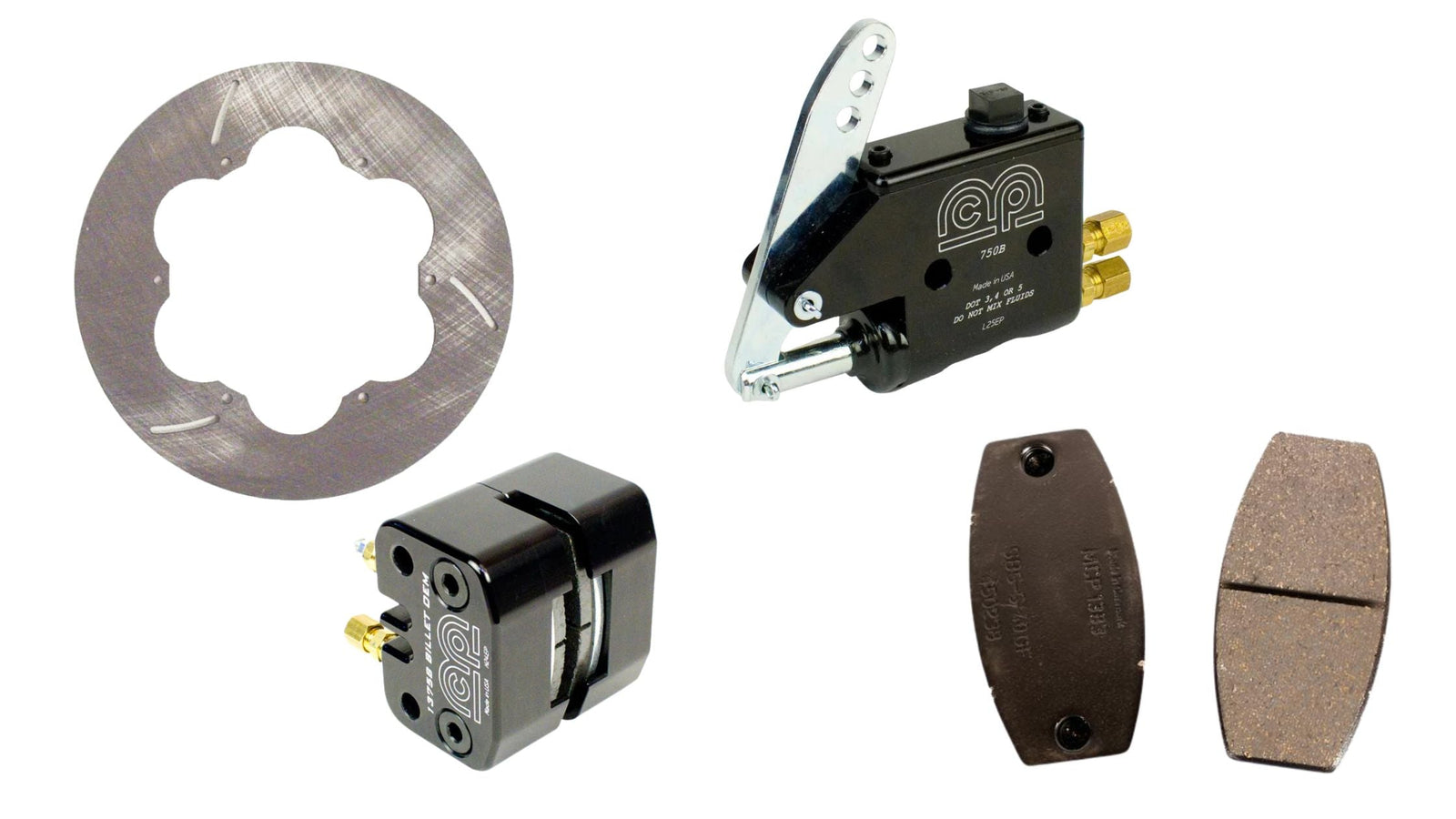

Braking is not just about slowing the kart down. It controls corner entry speed, chassis stability, and how consistently a driver can hit the same reference point lap after lap. A brake system that is working correctly is something a driver barely thinks about. One that is fading, soft, or inconsistent demands attention at exactly the moment a driver needs to be focused on the race.
Most brake problems in competitive karting are preventable. The brake pads, disc, caliper, and master cylinder all give warning signs well before a failure becomes a race-ending problem. Understanding what each part does and what wear looks like makes it straightforward to stay ahead of issues rather than chasing them.
Every kart brake system comes down to four components working together. A problem with any one of them affects the whole system, which is why diagnosing brake issues requires looking at all four rather than assuming the most visible part is the cause.
Brake pads create friction against the disc surface to slow the kart. They are the most frequently replaced component in the brake system and the first thing to inspect when braking performance changes. Pad compound affects how much heat is required before the brakes reach their working range, how much bite is available at the initial pedal application, and how consistent feel is across a full race session. Comet stocks a full range of brake pads sorted by kart brand, application and compound.
The brake disc rotates with the axle and absorbs the heat generated during braking. Disc condition directly affects stopping power and consistency. Thickness, style and the diameter of the disc all affect how much heat a brake disc can absorb. A disc that is warped, cracked, or has developed uneven heat spots cannot provide a consistent friction surface regardless of how new the pads are. The full range of brake discs includes options for different axle sizes and chassis platforms.
The brake caliper houses the brake pads and applies hydraulic pressure to clamp them against the disc. For the system to work correctly the caliper pistons must move freely in the caliper, apply even pressure across both pads simultaneously, and release cleanly when pedal pressure is removed. A caliper piston that sticks, applies uneven pressure, or drags causes both inconsistent braking feel and accelerated pad and disc wear. Brake calipers and rebuild parts are available for all major chassis platforms.
The brake master cylinder converts pedal input into hydraulic pressure and sends it through the brake lines to the caliper. The master cylinder and the fluid inside it are what make the system feel firm and predictable under hard braking. A master cylinder that is leaking internally, worn, or running old contaminated fluid is often the cause of a soft or inconsistent pedal that no amount of pad or disc work will fix. Rebuild kits and complete units are available in the master cylinder collection.
Brake pads wear faster than most racers expect, and they lose effectiveness before they are fully worn out. The friction material degrades through two mechanisms: physical wear from contact with the disc and thermal degradation from repeated heat cycles. A pad that looks like it still has material left can be glazed or heat-damaged in a way that significantly reduces its friction coefficient.
Glazing is one of the more common pad problems in competitive karting. It happens when pads are repeatedly heated to high temperatures without the rotational load needed to keep the surface fresh. A glazed pad has a hard, shiny surface that generates less friction than a properly conditioned pad. The symptom is reduced bite at the initial pedal application and a braking feel that is less sharp and confident than normal.
Pad thickness is the more obvious wear indicator. Most brake pads have a minimum thickness below which the metal backing plate begins to contact the disc. Running pads past this point damages the disc surface and can cause a sudden and significant loss of braking. Inspecting pad thickness visually before every race day takes less than a minute and is one of the highest-value maintenance habits available.
Compound selection also matters. Different pad compounds are designed for different operating temperature ranges. A pad that works well on a track with long braking zones and significant heat buildup may not reach its working temperature on a tighter track with shorter braking events. If braking feel is inconsistent across different venues with the same pads, compound selection is worth reviewing alongside the other variables.
Track Insight: If braking feel changes across a session from sharp and confident early to vague and less responsive later, the pads are likely overheating. This is often a compound issue rather than a worn pad issue.
MCP 1383BN Rear Caliper Brake Pad, Pair
View ProductThe brake disc takes on every heat cycle the system generates and absorbs the friction load from the pads on every braking event. Over time that load accumulates in ways that affect disc geometry and surface condition. A disc in good condition provides a consistent, flat friction surface that the pads can work against evenly. One that is worn, warped, or heat damaged provides neither.
Warping is the most common disc failure mode in karting. It happens when the disc is subjected to rapid or extreme temperature changes, most often when a very hot disc contacts standing water on a wet track or when the brakes are applied hard immediately after a long cool-down period. A warped disc produces a pulsing sensation under braking as the caliper alternately contacts the high and low points of the disc surface. This pulsing is specific to braking events and stops when brake pressure is released, which distinguishes it from other sources of vibration.
Disc surface condition affects pad performance directly. Scoring, grooving, or hard spots prevent the pad from making even contact, which reduces effective friction area and creates inconsistent braking feel. Hard spots are areas of the disc that have been locally overheated and then quench-hardened. They show up visually as discolored patches, often blue or purple, on the disc face.
Disc thickness is the most objective wear indicator. Measuring thickness at multiple points across the surface tells you both how much total wear has occurred and whether wear is even. Uneven thickness indicates a caliper that is not applying pressure evenly and should prompt a caliper inspection alongside disc replacement. Vibration under braking that cannot be traced to a warped disc is covered in depth in Why Is My Kart Vibrating at Speed, which includes a full diagnostic sequence for chassis and brake-related vibration sources.
MCP 562 Front Brake Disc, 7 1/2" x 1/8"
View ProductThe caliper and master cylinder are the hydraulic heart of the brake system. When both are working correctly, the system transmits pedal input to the disc with precision and consistency. When either develops a problem, the symptom is almost always felt through the pedal before it is visible anywhere on the kart.
Caliper piston leaking is the most common caliper issue. When the seals on the piston start to wear they can suck air from the outside and will not properly seal the brake system. This introduces air into the caliper and brake lines which is noticeable by a longer brake pedal and uneven pad wear. You might also start to see brake fluid leaking from the caliper.
A leaking caliper applies brake pressure unevenly across the two pads and may not release fully when pedal pressure is removed, causing the pads to drag against the disc constantly. Dragging causes rapid pad and disc wear, generates significant heat during a session, and produces a kart that feels slower than it should because the brakes are partially applied at all times.
Uneven pad wear is the clearest diagnostic indicator of a caliper problem. If one pad is visibly thinner than the other after a session, the caliper is not applying pressure evenly. This is worth addressing immediately because uneven wear accelerates the pace at which both the thinner pad and the disc reach the end of their service life.
Most caliper seal issues are fixed with installing new seals and pistons. Eventually the brake caliper piston bore will wear out and the caliper will need to be replaced, but most calipers last years before that is necessary.
MCP 1375B Billet OEM Rear Caliper Assembly with Pads
View ProductThe master cylinder controls pedal feel and pressure consistency. A master cylinder that is worn or has internal seal damage allows hydraulic fluid to bypass the piston internally, which reduces the pressure delivered to the caliper for a given pedal input. The driver experiences this as a pedal that feels progressively softer or that requires more travel than usual to generate the same braking force. Brake fluid condition directly affects master cylinder performance. Fluid absorbs moisture over time, which lowers its boiling point and reduces its effectiveness under the sustained heat of racing. A master cylinder running old or contaminated fluid will produce an inconsistent pedal that gets worse as the session progresses. Like the brake caliper, most master cylinder issues are remedied by rebuilding the master cylinder with new seals, pistons and parts.
MCP 750 Anodized Brake Master Cylinder, 3/4" Bore
View ProductBrake problems in competitive karting follow recognizable patterns. Most issues can be traced quickly once the symptom is understood correctly.
Brake maintenance is straightforward and does not require specialized knowledge or equipment beyond what is already in a well-equipped race kit. The components that need attention are the same ones covered above, and the inspection sequence follows the same logical order.
Brake components should be replaced based on condition rather than a fixed schedule. The right time to replace a part is when it can no longer perform its function reliably, and the inspection habits above make it straightforward to catch that point before it affects race performance.
How do I know when to replace kart brake pads?
The clearest indicators are visible wear and uneven thickness between the two pads in the same caliper. Inspect pads before every race day by looking at the friction material remaining. If either pad is visibly thin, or if one pad is noticeably thinner than the other, replace both pads as a pair. Do not wait for braking performance to drop noticeably before replacing. By that point the pads are past their effective service life and may be close to metal-on-metal contact with the disc.
Why does my kart brake pedal feel soft?
A soft pedal is almost always caused by air in the brake lines, old or contaminated brake fluid, or internal master cylinder or brake caliper wear. Start by bleeding the system with fresh fluid using a proper bleeder tool. This removes air and replaces fluid in one step and resolves the majority of soft pedal complaints in karting. If the pedal remains soft after a thorough bleed, inspect the master cylinder and caliper for internal seal wear, damaged piston bore or leakage.
How often should I change kart brake fluid?
Brake fluid should be replaced at the start of every racing season at minimum, and bled mid-season if you are racing frequently. Fluid absorbs moisture from the atmosphere over time, which lowers its boiling point and reduces effectiveness under racing conditions. Fluid that looks clean can still be significantly degraded. Using a brake bleeder to flush and replace fluid is a quick job that has a direct impact on pedal feel and system reliability.
What causes kart brakes to fade during a race?
Brake fade in karting usually comes from one of two sources. Fluid fade happens when brake fluid reaches its boiling point under sustained heat and creates gas in the brake lines. Gas is compressible where fluid is not, which produces a pedal that travels further and feels softer as the session progresses. Pad fade happens when the pad compound overheats past its designed operating range and temporarily loses friction effectiveness. Fluid fade is addressed by replacing brake fluid regularly. Pad fade is addressed by selecting a compound that matches the heat levels at your specific track or going to a bigger brake disc. A thicker brake disc or going to a vented disc if using a flat disc can help absorb heat faster and keep your brakes from fading during a race.
Why is there a pulsing sensation when I brake?
Braking pulsation felt at the pedal on every braking event almost always indicates a warped brake disc. The caliper alternately contacts the high and low points of the warped surface, producing a rhythmic pulsing tied to disc rotation speed. A warped disc should be replaced. If the pulsing is felt through the chassis broadly rather than specifically at the pedal, the source may be elsewhere. A full vibration diagnosis sequence is available in Why Is My Kart Vibrating at Speed.
Can I bleed kart brakes myself?
Yes, and it is one of the more straightforward maintenance tasks on a competition kart. A brake bleeder tool on most karts attaches to the master cylinder and pushes fresh fluid through the system to the brake caliper bleed screws. The process takes five to ten minutes, requires only a couple wrenches, bleeder tool and fresh brake fluid, and produces a noticeably firmer pedal when done correctly.
The kart brake system is simple but it has no margin for error. Pads, discs, calipers, and master cylinder all need to work together to deliver the consistent, predictable braking that allows a driver to push deeper into braking zones with confidence. When any one component is worn or degraded, the whole system suffers and the driver compensates without always realizing what they are compensating for.
Staying ahead of brake wear does not require much time or money. Inspecting brake pads before every race day, replacing brake fluid at the start of every season, and understanding what each symptom is telling you keeps the system reliable across a full season of competitive racing. The lap time gains from consistent braking are real, and they are available to any racer who treats the brake system as an active part of race preparation rather than a background concern.
 2650 West Main Street Greenfield, IN 46140
 317-462-3413