
Winning races takes more than raw speed. It takes a kart that is prepared to perform from the first heat to the final. The racers who consistently run at the front aren't just fast drivers. They're disciplined about maintenance. They know which parts are working against them before they push off the grid, and they deal with wear proactively instead of reactively.
Some components on a competition kart wear much faster than others. Ignore them long enough and you're not just losing lap time. You're setting yourself up for a DNF, a bad qualifying run, or a handling problem that sends you chasing setup changes that have nothing to do with your actual issue. A stretched chain doesn't feel like a stretched chain. It feels like the kart is soft off the corners. Worn brake pads don't announce themselves with a warning light. They show up as a braking point that suddenly moved.
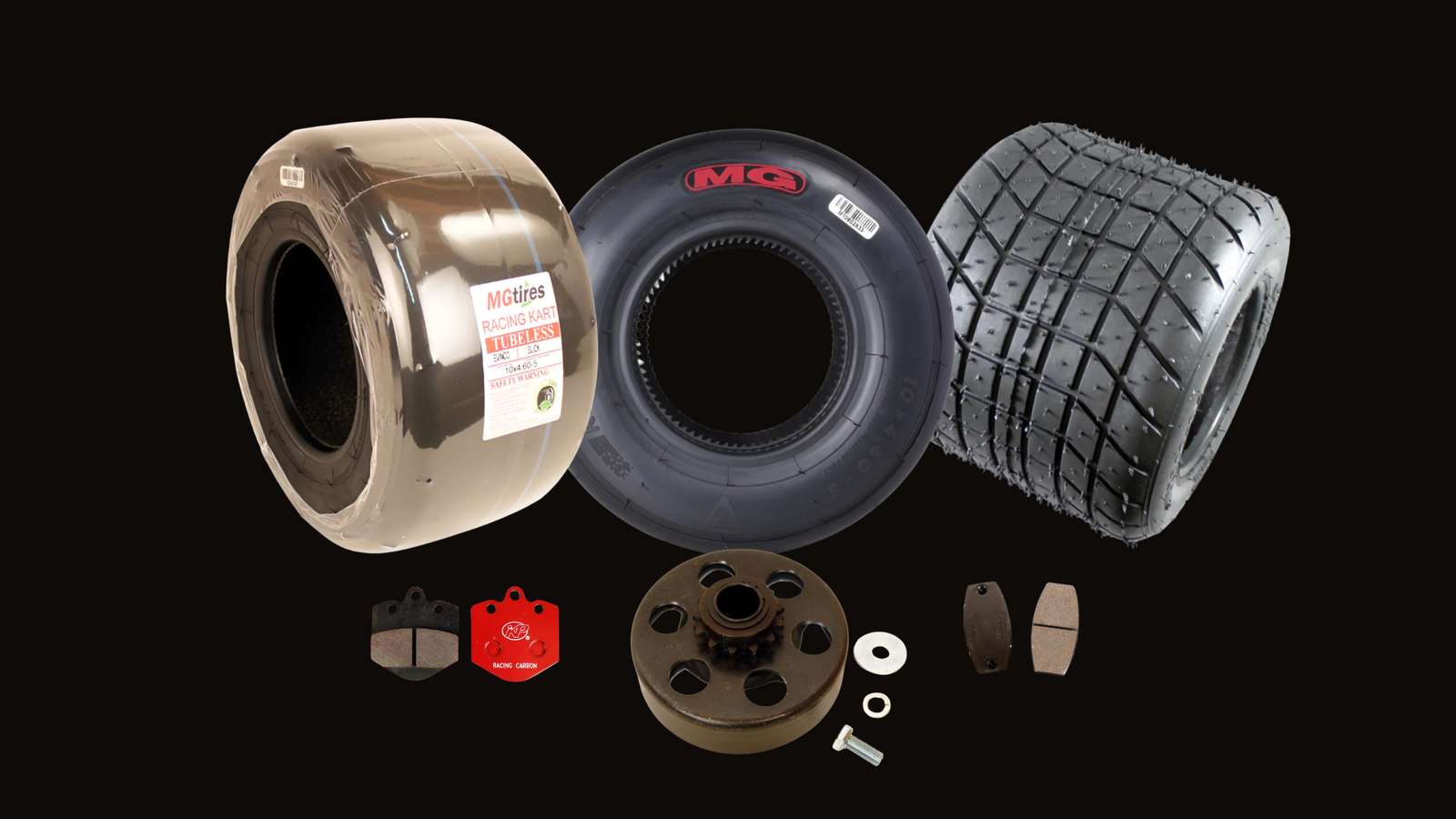
This guide covers the five parts that wear out first on a competition kart, what the warning signs actually look like, and when to replace them before they cost you something you can't get back on race day.

Tires are the foundation of everything your kart does. Acceleration, braking, cornering, and chassis balance all depend on the contact patch between the rubber and the track surface. When that contact patch degrades, every other variable on the kart becomes harder to read and harder to set up correctly. Drivers often spend time adjusting caster, camber, or axle stiffness chasing a handling problem that is really just a set of tires that have given up.
Heat cycles are the primary enemy. Every session adds another cycle, and each one gradually hardens the rubber compound and reduces its ability to generate grip. Tires that were excellent in the morning can feel noticeably different by the afternoon, not because the track changed dramatically, but because the tires are no longer responding the way they were. Add in the physical abrasion from the track surface, the lateral loads through corners, and the stress of hard braking zones, and it becomes clear why tires are the most frequently replaced item in any competitive karting program.
The challenge is that tire wear doesn't always look dramatic. A tire that is visually intact can still be past its performance window. Grip drops gradually rather than all at once, which makes it easy to rationalize running a worn set one more race day. The problem is that every lap on a tire that is past its best is a lap where the chassis is not doing what you think it's doing, the data you are collecting is not reflecting the setup you think you're running, and you are losing quality track time to competitors on fresher rubber.
What to watch for: Thin or non-existent wear indicator holes, cupping or scalloping along the inside edge of the tire, graining or tears on the tire contact patch, and any noticeable drop in corner grip consistency across a session. If the kart suddenly requires more input to rotate or feels reluctant to hook up coming off slow corners, check the tires before adjusting anything else on the chassis.
Track Tip: Match your compound to track conditions and surface temperature, and don't stretch a worn set trying to save money. The lap time you lose on tired rubber is far more expensive than a fresh set. If you are unsure whether a tire has another race day left in it, it probably doesn't.
Browse Competition Tires from MG, Bridgestone, Hoosier, Burris, and more.
The chain and sprocket are responsible for transferring every bit of power your engine produces to the rear axle. They operate under continuous load, through heat, dirt, and the repeated stress of acceleration and deceleration across an entire race day. It is a simple system, but because it is always working, it wears steadily, and the consequences of ignoring that wear can be immediate and race-ending.
Chain stretch is the most common issue. As a chain accumulates hours, the pins and rollers inside it wear slightly, and that wear adds up across every link. The result is a chain that is effectively longer than it was when new. A stretched chain sits differently on the sprocket teeth, doesn't transfer power as cleanly, and creates a slapping or rattling sound under load that is easy to dismiss as normal kart noise until something skips or snaps. Sprocket wear compounds the problem. As teeth take on a hooked or asymmetric shape from repeated chain contact, the engagement between chain and sprocket becomes less precise. The two worn components accelerate each other's deterioration, which is why it makes sense to replace the chain and sprocket together rather than swapping just one.
Front sprocket wear is often overlooked compared to the rear. Because the front sprocket on the engine is smaller and spinning faster, it actually wears quicker relative to the rear. It is worth inspecting both at the same time and not assuming that because the rear looks acceptable, the front is fine too.
What to watch for: Audible slop or rattle in the drivetrain under acceleration, chain that won't hold proper tension after adjustment, visible chain stretch when you pull a section away from the rear sprocket, or sprocket teeth that have developed a hooked, sharpened, or asymmetric profile instead of clean even edges. Either component showing significant wear is reason enough to replace both.
Track Tip: Inspect chain slack and sprocket tooth shape before every race day, not just when something sounds wrong. Lube the chain after every race day as part of your standard teardown routine. A dry or stretched chain gives very little warning before it causes a problem on track. A new chain is never a bad decision.
Chains and Master Links | Sprockets | Chain Lube

Karting brakes work harder than most drivers give them credit for. Sprint racing in particular puts brakes through repeated cycles of high-speed deceleration followed immediately by hard acceleration, with very little time for heat to dissipate in between. That thermal load eats through pad material quickly, and on a competitive kart where brake feel and consistency are directly tied to how confidently you can push your braking points, worn pads are not just a safety issue. They are a performance problem.
Pad wear is straightforward enough to understand, but the way it affects feel on track is more nuanced than simply having less material. As pads thin out, pedal travel increases and the initial bite point becomes less defined. Drivers often interpret this as the kart understeering into corners or as a chassis balance issue rather than a brake issue, especially if the wear happened gradually over several race days. Glazed pads cause a different problem. High heat with insufficient cooling can bake the surface of the pad compound, creating a hard glassy layer that reduces friction and can produce a metallic squeal under braking. Glazed pads can feel firm on the pedal while delivering significantly less actual stopping force.
Brake fluid is equally important and more frequently neglected. Brake fluid absorbs moisture from the atmosphere over time, and as it does, its boiling point drops. Under hard repeated braking, degraded fluid can begin to vaporize inside the brake lines, creating a compressible gas pocket that produces exactly the soft spongy pedal feel that drivers often blame on air in the system or a failing master cylinder. Flushing and replacing brake fluid is one of the simplest maintenance tasks on a kart, and it makes a meaningful difference in pedal consistency and feel.
What to watch for: Thin or glazed pad material visible on inspection, a metallic squeal or grinding sound under braking, increased pedal travel before bite, reduced stopping power at your usual braking markers, or a pedal that feels inconsistent or spongy from lap to lap. Any of these should be addressed before you go back on track, not after the session.
Track Tip: Replace pads before they show significant wear rather than waiting for performance to drop noticeably. Bleed brake fluid at the start of every season and check it at regular intervals through the year. It is one of the cheapest and fastest maintenance tasks in karting, and it has a direct effect on how confidently you can brake late.
Brake Pads | Brake Fluid | Brake Bleeder
Spark plugs sit at the top of almost every mechanic's list of overlooked consumables, and for good reason. They are inexpensive, they take minutes to replace, and the symptoms of a worn or fouled plug are subtle enough that they get misdiagnosed constantly. A driver running on a degraded plug is likely to chase jetting changes, air filter issues, or carburetor problems before ever thinking to pull the plug and look at it. This is a frustrating and time-consuming way to discover that the fix cost a few dollars and five minutes.
What a spark plug actually does is straightforward: it delivers a precisely timed spark to ignite the air-fuel mixture in the combustion chamber. When the electrode wears or the plug fouls, that spark becomes inconsistent. The engine still runs, but not cleanly or confidently. Off slow corners where the engine is working hard to build RPM, an inconsistent spark shows up as a stumble or hesitation. On the straights, it can produce a flat feeling at the top of the RPM range that is easy to confuse with a gearing or jetting issue. In worst-case scenarios, a badly fouled plug causes misfires that are noticeable as a rhythmic roughness in the engine note.
Reading a plug is also one of the most useful tuning habits a competitive racer can develop. The color and condition of the electrode after a session tells you a great deal about combustion temperature, fuel mixture, and overall engine health. A light tan or gray electrode indicates a healthy mixture. A black sooty electrode suggests running rich. A white or blistered electrode points to a lean condition. Building the habit of reading the plug regularly means you catch jetting and mixture issues early, before they cause engine damage or cost you a race.
What to watch for: Difficulty getting the engine to start cleanly, a stumble or hesitation off slow corners, a flat or slightly gutless feeling at the top of the RPM range, or visible electrode wear, fouling, or deposit buildup when you pull and inspect the plug. If the engine is running slightly off and nothing else has changed, pull the plug before touching anything else.
Track Tip: Carry at least one spare plug in your toolbox at every race event. A fresh plug takes two minutes to install and has saved countless race days. Replace plugs on a schedule based on engine hours rather than waiting for something to feel wrong, and make reading the plug after sessions a regular part of your race day routine. A new plug after running in rain conditions is always a good idea.

The clutch is one of those components that rarely gets attention until it fails visibly, but that steadily costs performance long before it reaches that point. In four-cycle racing particularly, the clutch is doing significant work at every slow corner exit and every standing start, engaging and slipping under load while managing heat that builds up quickly and dissipates slowly. Weights, springs, and friction surfaces all wear with use, and as they do, the clutch gradually loses the crisp, predictable engagement that is essential for getting good drive off the corners.
The tricky part about clutch wear is how it presents on track. A clutch that is past its service life typically doesn't produce a dramatic failure. It just softens. Corner exits that used to feel immediate start to feel slightly delayed. The kart doesn't hook up quite as quickly coming off the bottom of the corner. Starts feel a little flat. Because the change is gradual, it is easy to rationalize as a track condition issue or a gearing issue or just a bad run. The driver adjusts their driving style to compensate without realizing the problem is mechanical. Lap times quietly get worse, and the gap to the front of the field that used to be manageable starts to grow.
Engagement RPM is the clearest indicator of clutch health. Every clutch is set to engage at a specific RPM, and that RPM drifts as the clutch wears. If your engagement RPM has moved from where it was set without any intentional adjustment, the clutch is telling you something. Clutch weight and spring wear are the usual culprits, and both are straightforward to inspect and replace. Checking engagement RPM as a regular part of your maintenance routine takes minutes and gives you an early warning before wear affects performance on track.
What to watch for: A burning smell after a race or practice session, sluggish or soft acceleration off slow corners, delayed or inconsistent engagement that makes corner exits feel unpredictable, difficulty getting a clean launch off the start line, or an engagement RPM that has drifted noticeably from where it was originally set. A worn clutch rarely announces itself all at once. It just quietly takes a little more time off your corner exits until you address it.
Track Tip: Check engagement RPM and inspect weights, springs and drum wear on a regular schedule throughout the season, not just when something feels wrong. A clutch that is even slightly out of spec is affecting every launch and every slow corner exit on every lap of every race.
These five categories of parts wear the fastest and have the most direct effect on whether your kart finishes and how competitive it is when it does. They are the first things to inspect at the start of a season, the first things to check when something feels off mid-season, and the first places to look when lap times start slipping without an obvious explanation.
The pattern across all five is the same: wear happens gradually, the symptoms are easy to misread as something else, and by the time performance drops noticeably the damage to your race program has already been done. Proactive replacement is always cheaper than reactive troubleshooting, whether the cost is measured in parts, in lap times, or in race results.
There is a second layer of maintenance that every competitive racer needs to stay on top of as well. Engine oil and fluids, air filters, carburetor components, axles and bearings, and safety gear all have their own replacement schedules and their own warning signs. Those deserve their own breakdown, and we will cover them in a follow-up guide.
In the meantime, browse Comet's full parts catalog to make sure your kart is ready for whatever is next on the schedule: cometkartsales.com.
 2650 West Main Street Greenfield, IN 46140
 317-462-3413