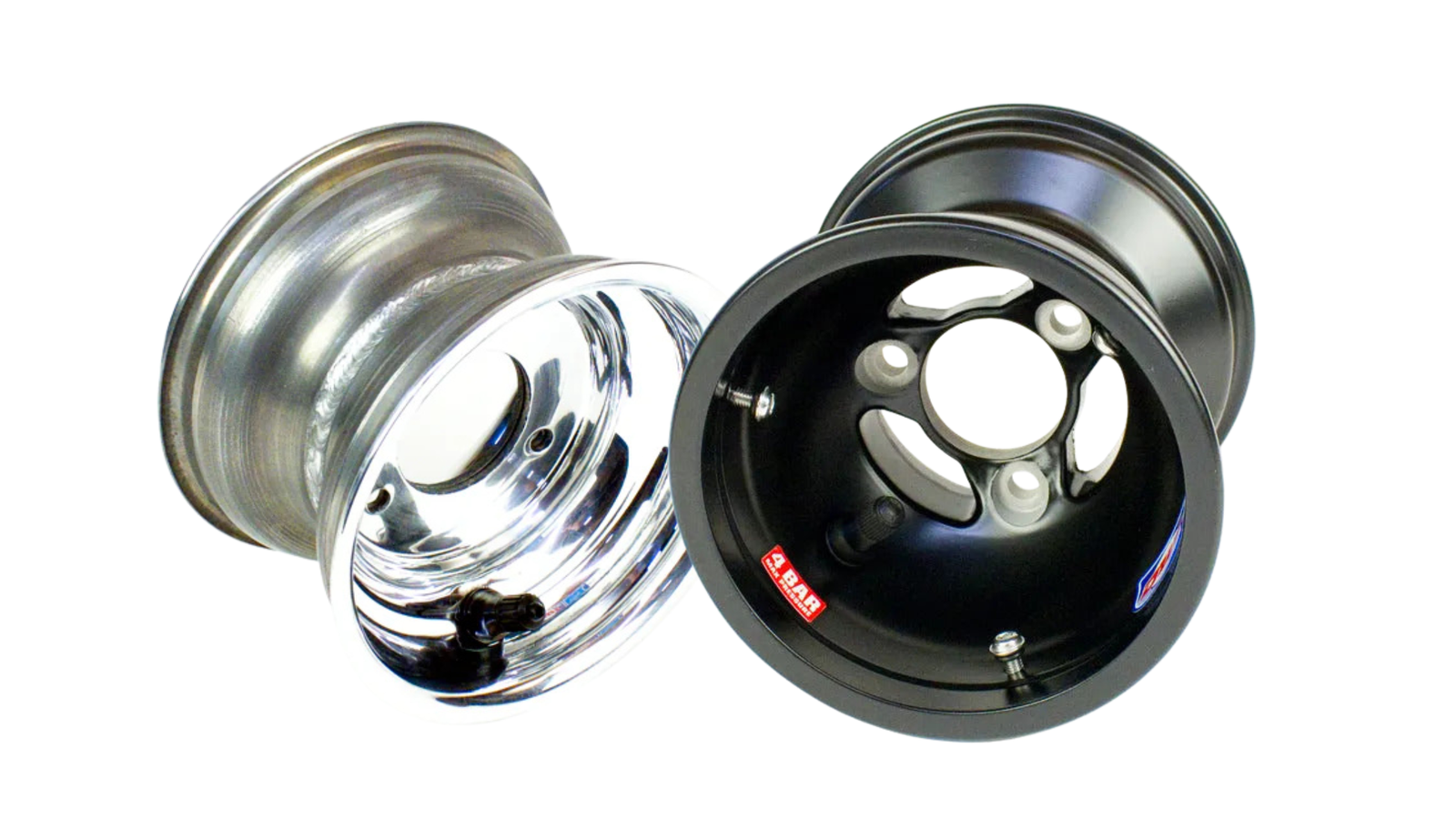

Most racers spend a lot of time thinking about tires and relatively little time thinking about the wheels those tires are mounted on. That is a missed opportunity. The wheel is not just a structural component that holds the tire in place. It directly affects how quickly the tire reaches operating temperature, how stable tire pressure stays across a run, and how the overall setup responds to changing conditions. Choosing the right kart wheel for your track and conditions is one of the more accessible tuning adjustments available, and understanding the variables involved makes it easier to use wheel choice deliberately rather than defaulting to whatever came with the kart.
The connection between wheel choice and performance is less obvious than the connection between tires and performance, which is probably why wheels get less attention than they deserve. But the two are inseparable. A tire can only perform within the range that the wheel allows, and a wheel that is mismatched to the conditions limits what even a well-chosen tire compound can do.
Heat is the primary mechanism at work. Karting tires need to reach a specific operating temperature to generate their designed level of grip. Get there too slowly and the tire never comes in properly. Get there too quickly and the tire overheats and loses consistency. The wheel material plays a direct role in how quickly heat builds in the tire because the wheel conducts heat between the tire, the air inside it, and the rim surface. A wheel that transfers heat quickly gets the tire up to temperature faster. A wheel that transfers heat more slowly keeps things more stable across a longer run.
Pressure stability follows from the same mechanism. As tire temperature rises, pressure rises with it. A wheel material that generates more heat will also produce more pressure rise across a session. That pressure rise changes the tire's contact patch and affects grip consistency from the first lap to the last. Racers who find that the kart handles well early in a run and deteriorates as pressure builds often have a wheel and tire combination that is generating more heat than the conditions warrant.
Width adds a separate but equally important variable. Wheel width changes the tire's contact patch directly, which affects how much grip is available and how the kart transfers weight. Front and rear width can be tuned independently, giving the setup additional degrees of freedom beyond what axle and seat changes provide. Wheel width also changes how much a tire's side wall flexes. A narrower wheel will have more tire side wall flex than a wider wheel with the same tire.
The choice between aluminum and magnesium is the most fundamental wheel decision in competitive karting and the one that has the most direct impact on how the tire performs. Both materials are used at the highest levels of the sport, and neither is universally better. The right choice depends on the conditions, the tire compound, and the specific demands of the track.
Magnesium wheels transfer heat more slowly than aluminum. Magnesium is a pourous material with lots of tiny air pockets in the material. This porosity slows down the heat transfer inside the wheel. This makes them better suited to conditions where the priority is pressure stability and consistency across a long run. On high grip surfaces, in warmer conditions, and on long runs, magnesium wheels help the setup stay predictable across a session without building excess heat. They are also a more forgiving choice for racers who are still learning how to read tire behavior, because the slower heat buildup gives more time to adjust before the tire is fully committed to a temperature window..
Aluminum wheels transfer heat faster and get tires up to operating temperature more quickly. On low grip tracks, in cooler conditions, or in sprint formats where the tire needs to be working from the first lap of a short heat race, aluminum’s faster heat transfer can be an advantage. The tire reaches its ideal pressure and temperature window sooner, which means more grip earlier and a faster driver-kart combination at the start of a run. The tradeoff is that aluminum wheels require more attention to pressure management. Because they generate more heat, they also generate more pressure rise, and a tire that was correctly pressured before the session may be significantly over-pressured a few laps in if the wheel choice is not matched to the conditions.
Aluminum wheels come in two types, cast aluminum and spun aluminum. Cast aluminum wheels are thicker and will retain more heat than spun aluminum wheels that are a thinner material. Cast aluminum wheels are best used with rain tires, where heat and pressure build up are hard to attain. Cast aluminum wheels are also stiffer which helps generate mechanical bite in cold or wet conditions. Spun aluminum wheels are best used in dry conditions. They are typically less expensive than Magnesium wheels and can be used in similar conditions as Magnesium wheels.
Track Insight: If your tires are taking too long to come in and the kart feels cold and understeering for the first several laps of every session, wheel material is worth examining before changing tire compound or adjusting chassis setup. Moving from aluminum to magnesium wheels is one of the faster ways to address an issue with too much heat build up and late race inconsistency. .
Wheel width changes the tire's footprint on the track surface and is one of the most direct ways to adjust grip balance between the front and rear of the kart. Width adjustments are made independently at each end, which gives the setup considerable flexibility. Most racers focus on rear width because it has the most obvious effect on rear grip and chassis behavior, but front width is an equally important variable that is easier to overlook.
While wider rear wheels increase the tire contact patch, they also make the side wall stiffer which can reduce rear grip.. On a track or in conditions where the rear is struggling to hook up, narrowing the rear wheel stance is a straightforward way to increase rear traction. It also tends to make the kart more stable under acceleration and through high speed corners where rear grip is the priority. The tradeoff is that too much sidewall flex in high grip conditions can make the kart difficult to rotate, with the rear refusing to step out enough to allow clean corner entry. Matching rear width to grip level is part of the same conversation as axle stiffness and seat choice.

Front wheel width affects steering response and turn-in behavior. Narrower front wheels make the side wall of the tire softer which will add front grip, which sharpens turn-in and makes the kart more responsive to steering input. This can be beneficial on tracks with tight technical corners where the kart needs to react quickly to steering. Wider front wheels reduce front grip and slow the steering response slightly, which can help on faster tracks where the kart is sensitive at the front or where the driver needs a more progressive feel through high speed corners. Front width adjustments work alongside wheel hub (https://cometkartsales.com/collections/wheel-hubs) selection, as hub length is the primary mechanism by which front and rear track width is adjusted.
The practical application of wheel choice comes down to reading conditions accurately and matching material and width to what the track is asking for. The same kart on the same track with different wheel choices can feel meaningfully different, and building a habit of considering wheels alongside tires, axles, and seat choice gives the setup more tools to work with.
Low grip conditions favor aluminum wheels and narrower rear widths. When grip is limited, the priority is generating enough rear traction to allow the chassis to work, and aluminum's faster heat buildup helps mechanical grip as well as helps build air pressure quicker. A narrower rear stance helps the setup add grip to the rear of the kart. . Pairing aluminum wheels with the right axle choice from Comet's axle collection (https://cometkartsales.com/collections/axles) gives two complementary tools for managing low grip conditions.

High grip conditions favor magnesium wheels and wider rear widths. When the track has significant grip, the challenge shifts from generating traction to managing it. Magnesium wheels manage air pressure build up and tire temperature better than aluminum over long runs in high grip situations. . Wider rear widths help keep the kart free especially in high grip situations where a narrower setup would cause the kart to have too much rear grip and bog down. .
Long runs and endurance formats generally favor magnesium wheels regardless of grip level. Pressure stability becomes increasingly important as a run extends, and magnesiums more controlled heat buildup keeps the tire in a more consistent pressure window over many laps. Racers who run in high grip situations or high temperatures should factor run length into wheel material selection alongside the grip conditions at that specific track.
Comet carries an extensive range of kart wheels across materials, sizes, and bolt patterns. Douglas and Swift are among the most widely used brands in competitive karting and both are well represented in the catalog.
Douglas aluminum wheels are one of the most established options in American karting.

The Douglas spun aluminum wheel range (https://cometkartsales.com/collections/douglas-dwt-us-pattern-spun-aluminum-kart-wheels) covers the US pattern bolt layout that is standard on many American built chassis, with multiple width options available across front and rear fitments. Douglas aluminum wheels are known for consistent performance across a wide range of conditions and are a reliable baseline choice for racers who compete at multiple tracks with varying grip levels.

Douglas magnesium wheels are available through the Douglas magnesium collection (https://cometkartsales.com/collections/douglas-dwt-magnesium-kart-wheels) and offer the slower heat transfer characteristics of magnesium in the same familiar Douglas sizing. The Douglas Magnesium wheels are all metric bolt pattern. . They are a natural upgrade path for racers already running Douglas aluminum wheels who want to experiment with more controlled tire warm-up without changing anything else in the setup.
Swift magnesium wheels are a popular metric pattern option for racers running European chassis platforms. Swift magnesium wheels are available in 130mm, 180mm, and 212mm widths, covering the standard sizing for both front and rear fitments on metric bolt pattern karts.

No list would be complete without mentioning OTK Tony Kart’s MXC Magnesium Wheels. The MXC wheels are well known in the karting industry for their superior on track performance and are considered the gold standard for Magnesium karting wheels. They are expensive but they are also one the most popular wheels in all of karting for a reason. You can see all the OTK Magnesium and Cast Aluminum Wheels on the OTK Tony Kart Wheel Page (https://cometkartsales.com/collections/otk-tony-kart-wheels).
Browse the full wheels collection (https://cometkartsales.com/collections/wheels) to see all available options across both bolt patterns and materials.

Wheels are more durable than most consumable parts on a kart but they are not indestructible, and running a damaged wheel creates problems that range from inconsistent handling to a genuine safety risk.
Visible bending or deformation from contact or curbing is the clearest reason to replace a wheel. A bent rim does not hold a tire evenly, creates an imbalance that generates vibration at speed, and produces the same rhythmic handling inconsistency that a chassis imbalance would produce. Racers who find the kart handling inconsistently after a significant contact and cannot identify a setup reason should check the wheels carefully before making any adjustments.
Bead seat damage is a related issue that directly affects tire sealing and pressure stability. The bead seat is the area of the rim where the tire bead contacts and seals against the wheel. Impact damage, repeated hard mounting and dismounting cycles, or simply age can damage the bead seat surface in ways that prevent a proper seal. A tire that loses pressure gradually across a session, or that requires frequent reseating, often has a damaged bead seat rather than a valve or tire problem. Run a finger around the inside of the bead seat area of any wheel that has been through significant use or a hard impact. Any roughness, cracking, or deformation in that area means the wheel should be retired.
Inconsistent pressure holding across sessions without a clear cause is a softer indicator that the wheel is no longer performing as it should. A wheel that seals correctly holds pressure predictably between sessions and builds it consistently during a run. One that is showing unusual pressure behavior warrants close inspection before the next race day.
Track Insight: A bent wheel frequently gets misdiagnosed as a setup imbalance or chassis problem. If the kart starts handling inconsistently after contact and nothing in the setup explains it, put the kart on a stand and spin each wheel slowly while watching for any runout or wobble before making any other changes.
If you have a slow leaking tire check your beadlock o-rings, cracks in the wheel and your tire air valve for issues or damage.
Wheel material and width are real tuning variables that work alongside tires, axles, and seat choice to determine how the kart performs across changing conditions. Magnesium for stability and consistent pressure across longer runs. Aluminum for faster heat buildup and earlier grip in low grip or rain conditions s. Wider rear for less grip , narrower for increased traction. . Front width for steering response. None of these adjustments are complicated, but all of them require understanding what the wheel is doing before reaching for a different adjustment elsewhere in the setup.
 2650 West Main Street Greenfield, IN 46140
 317-462-3413