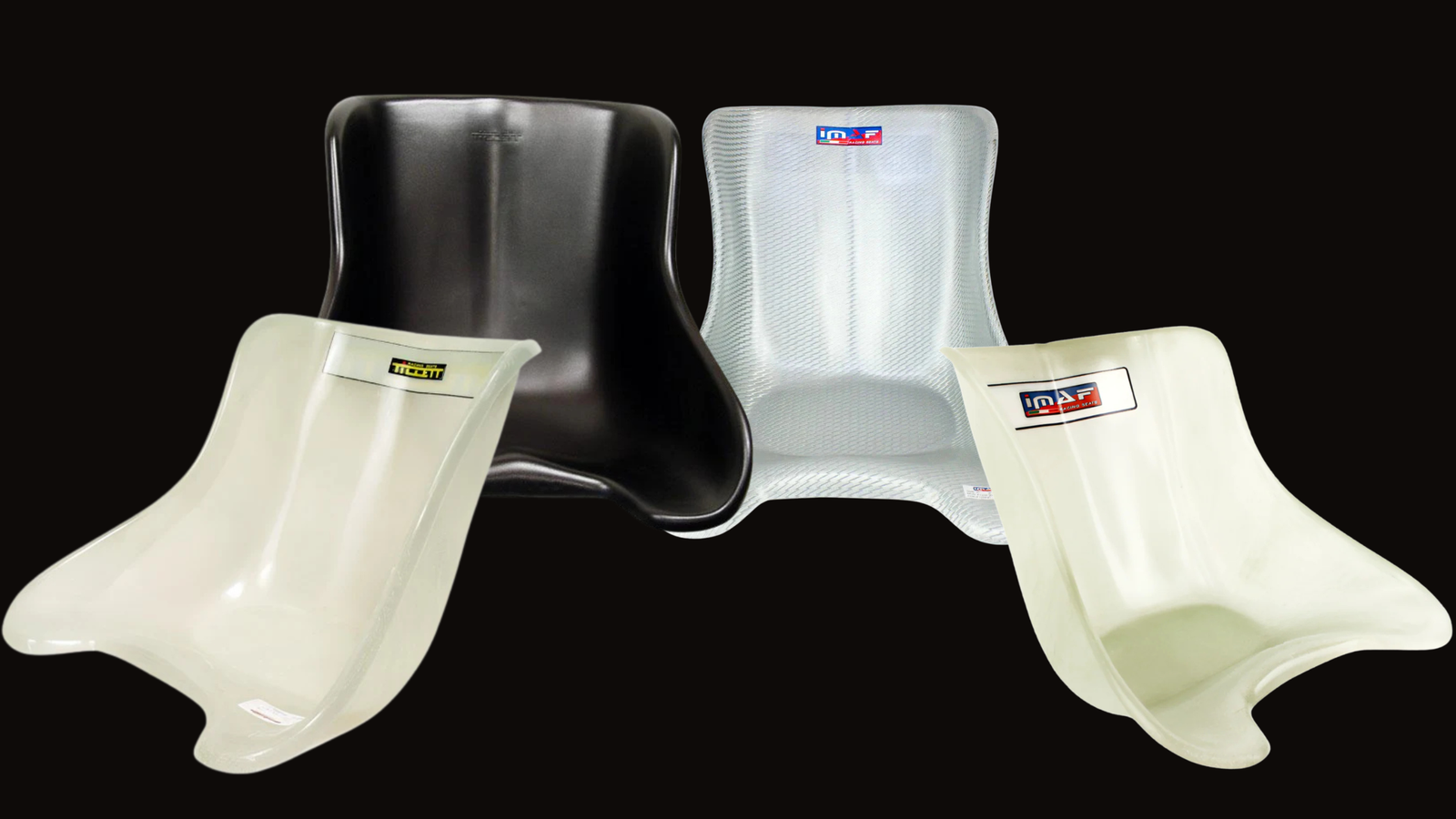

Ask most drivers what the seat does on a kart and they will tell you it holds the driver. That is true, but it is only part of the answer. On a competition kart, the seat is one of the most influential tuning variables available. It directly affects how the chassis flexes, how weight transfers through corners, and how consistently the kart responds lap after lap. Getting the seat choice right makes the rest of the setup easier to work with. Getting it wrong means fighting the kart all day without understanding why.
A kart chassis generates grip through controlled flex. Unlike a car, which has suspension to absorb and manage load transfer, a kart works by allowing the chassis itself to twist and deflect slightly through corners. The seat sits at the center of that flex and plays a significant role in how freely the chassis can move. A seat that is too stiff for the conditions restricts that movement. A seat that is too soft allows more flex than the conditions require. Either situation affects rear grip and balance in ways that feel like a chassis problem but are actually a seat problem.
The impact is most noticeable in rear grip and chassis balance. A seat that is well matched to the conditions allows the inside rear wheel to lift naturally through corners, which is the primary mechanism by which a kart generates grip and rotates. A seat that is fighting the chassis in either direction makes that lift inconsistent, which shows up as understeer, oversteer, or a kart that simply does not respond predictably to driver inputs.
Over a longer stint, seat choice also affects consistency. A driver who is well supported in the seat and moving with the chassis rather than against it maintains more consistent inputs lap over lap. Fatigue and inconsistency compound each other in a race. Matching the seat to both the conditions and the driver goes a long way toward keeping lap times stable from the first lap to the last.
Browse complete karts and chassis at Comet: https://cometkartsales.com/collections/complete-karts

Seat stiffness is the primary variable in seat selection for competitive karting. The same driver on the same chassis on the same track can experience meaningfully different handling simply by changing seat stiffness, without touching tire pressures, axle selection, or any other setup element. Understanding what each stiffness level does allows you to use the seat as a deliberate tuning tool rather than a fixed variable.
Softer seats allow more flex in the chassis and add rear grip. They are well suited to low grip conditions, cooler track temperatures, or early in a race day before the track has fully rubbed in. A softer seat lets the chassis work more freely, which helps the kart generate the rear traction it needs when grip is limited. Drivers who are struggling to rotate the kart or finding the rear reluctant to engage coming off slow corners often benefit from moving to a softer seat before chasing the same result through axle or tire pressure changes.
Stiffer seats restrict chassis flex and free up the rear of the kart. They are better suited to high grip conditions, fully rubbed-in tracks, or warmer sessions where grip levels have built significantly. On a high grip surface a chassis that is too free becomes a handling problem in the opposite direction, with the rear moving around more than the driver wants. A stiffer seat helps control that movement and gives the driver more confidence to push the rear of the kart without it stepping out.
Medium stiffness seats sit between the two extremes and serve as a baseline for most racers across a range of conditions. For a driver who races at multiple tracks with varying surface types, a medium stiffness seat is often the most practical starting point. It rarely produces the optimal result in extreme conditions at either end of the grip spectrum, but it is consistent and forgiving across a wider range of situations.
Track Insight: A seat stiffness change can solve a balance problem faster than chasing the same result through tire pressure or axle adjustments. If the kart is not responding to setup changes the way you expect, consider whether the seat stiffness is working with or against the conditions before making further adjustments.
Track conditions change throughout a race day and across different venues. The same seat that works well in qualifying may not be the right choice for the final if grip levels have shifted significantly. Building an understanding of how to read conditions and translate that into seat selection is one of the more useful skills a competitive racer can develop.
Low grip conditions, including cold mornings, damp tracks, green tracks with limited rubber laid down, or venues with a naturally low grip surface, favor a softer seat. The chassis needs to be as free as possible to generate rear traction when grip is limited, and a softer seat supports that by allowing more flex. Drivers who arrive at a new track and find the kart understeering early in the day should consider whether a softer seat is part of the solution alongside any other changes they are making.
High grip conditions, including fully rubbered-in tracks, warm afternoon sessions, or venues with a high grip racing line, favor a stiffer seat. As grip builds, the chassis naturally becomes more active and the rear can become loose if the setup does not account for it. Moving to a stiffer seat helps control that activity and keeps the rear planted without sacrificing rotation. Drivers who find the kart becoming increasingly difficult to manage as the day progresses and grip builds should look at seat stiffness as one of the adjustments available to them.
Changing conditions throughout a race day require awareness and flexibility. The instinct is often to chase changing balance through tire pressure or gearing adjustments, which are faster to make between sessions. But if the kart's fundamental balance is shifting with conditions across multiple sessions, seat stiffness is worth addressing directly rather than continuing to compensate around it. Pairing seat choice with axle selection (https://cometkartsales.com/collections/axles) gives you two complementary tools to manage rear grip across changing grip levels.

A seat that is the right stiffness for the conditions but the wrong fit for the driver undermines both performance and consistency. On a kart, the driver is a significant portion of the total vehicle weight and is directly coupled to the chassis through the seat. How the driver sits, how much they move, and how their weight is distributed all affect how the chassis behaves. A seat that fits well keeps the driver stable and in a consistent position, which means consistent inputs and consistent lap times.
Movement inside the seat is the main problem to avoid. A seat that is too large allows the driver to shift laterally under cornering loads. Each time the driver moves, their weight shifts in a way that is not predictable and not repeatable. The chassis responds to that movement, but not in the way the driver intended or expected. What feels like inconsistent handling is often inconsistent driver positioning inside an ill-fitting seat. The driver will also have to use some of their upper body strength to help hold themselves from sliding around in the seat, adding to fatigue and imprecise steering inputs.

Proper fit means the seat holds the driver snugly through the hips and lower back without requiring effort to stay in position. The driver should be able to feel the chassis moving under them rather than having to brace themselves against the seat. Padding can help fine-tune fit once a correctly sized seat has been selected, and seat mounting hardware (https://cometkartsales.com/collections/seat-hardware) and seat struts (https://cometkartsales.com/collections/struts) allow the seat position to be adjusted within the chassis to optimize weight distribution and driver comfort.

Rib support is directly connected to seat fit. A driver who is not well supported through the torso relies on their core muscles to stay stable through corners, which accelerates fatigue and degrades input quality over the course of a race. A well-fitted seat combined with a quality rib vest (https://cometkartsales.com/collections/rib-vest) distributes cornering loads more evenly and keeps the driver fresher and more consistent deeper into a stint.
The vast majority of competition karting seats are made from fiberglass. Fiberglass is the material of choice because it offers a well understood and tunable stiffness range, is relatively lightweight, and responds predictably to the loads placed on it during racing. The manufacturing process for fiberglass seats, particularly hand-laid construction, allows seat makers to control stiffness precisely and produce consistent results across sizes.
Tillett is one of the most widely used seat brands in competitive karting and Comet carries the full T11 range, which is among the most popular seat families in the sport. The T11 shape is known for its flat bottom design, which lowers the driver's center of gravity compared to seats with a more pronounced bucket shape. That lower center of gravity works particularly well on high grip tracks where managing chassis activity is a priority.

Within the T11 family, stiffness varies across three variants. The Tillett T11 Standard (https://cometkartsales.com/products/tillett-t11-unpadded-fiberglass-kart-racing-seat) is the baseline option, suited to a wide range of conditions and used as a starting point by many racers.
The Tillett T11T (https://cometkartsales.com/products/tillett-t11t-unpadded-fiberglass-kart-racing-seat-sku110338) is one step softer than the Standard, allowing slightly more chassis flex and adding a small amount of rear grip.
The Tillett T11VG (https://cometkartsales.com/products/tillett-t11vg-fiberglass-karting-seat-soft) is the softest of the three, best suited to low grip conditions or tracks where maximum rear traction is the priority. All three share the same T11 shape, which means a driver can move between stiffness levels without changing seat position or hardware.

Beyond the T11 range, Comet carries the full Tillett lineup including cadet-specific options and alternative shapes for drivers who need something different in terms of sizing or fit. Browse the complete Tillett seat collection (https://cometkartsales.com/collections/tillett-kart-racing-seats) or the full seats collection (https://cometkartsales.com/collections/seats) to see everything available.
Seats are not replaced as frequently as consumable parts, but they do have a service life and knowing when to replace one saves you from running compromised equipment without realizing it.
The clearest reason to replace a seat is visible cracking or structural damage. A crack in a fiberglass seat, even a small one, changes how the seat flexes and introduces an unpredictability into the chassis that is difficult to diagnose because it is not consistent. A cracked seat may feel fine in some conditions and erratic in others, and chasing that inconsistency through setup changes is a frustrating exercise with no good outcome. If the seat is cracked, replace it.
Stiffness degradation over time is a less obvious but equally valid reason. A fiberglass seat that has been through many heat cycles and races gradually loses some of its original stiffness. The change is subtle and easy to miss because it happens slowly, but over a full season a seat can shift meaningfully away from its original characteristics. If the kart feels like it has gotten progressively harder to set up and nothing obvious has changed, the seat's stiffness may have drifted enough to be worth examining.
Driver growth and class changes are practical reasons that apply particularly to younger racers and those moving between classes. A seat that fit correctly and was the right stiffness for a lighter driver in a junior class may not be appropriate once the driver has grown or moved into a heavier, higher grip senior class. Seat selection should be revisited any time the driver or class changes significantly.
The seat is not a set and forget component. It is one of the most influential tuning variables on a competition kart, and treating it as such gives you an additional tool to work with every time conditions change. Match stiffness to grip levels, fit the seat to the driver properly, and revisit the choice when the results are not what you expect. The drivers who understand what the seat is doing are the ones who can make adjustments quickly and confidently rather than guessing their way through a difficult setup day.
Browse the full range of kart seats (https://cometkartsales.com/collections/seats), seat struts (https://cometkartsales.com/collections/struts), and seat mounting hardware (https://cometkartsales.com/collections/seat-hardware) at Comet Kart Sales.
 2650 West Main Street Greenfield, IN 46140
 317-462-3413