


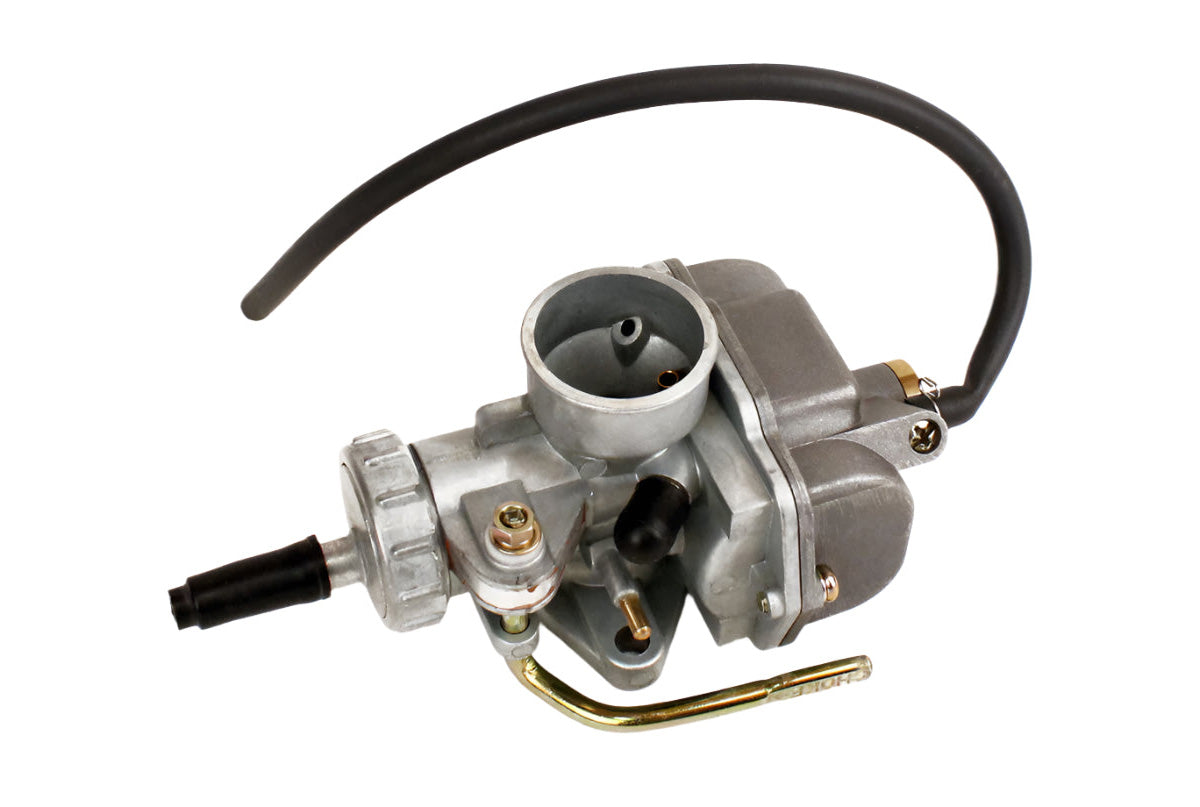

The carburetor is the heartbeat of any kart engine. It controls how power feels every time you hit the throttle. When the air-fuel mix is right, the engine pulls clean and strong. When it’s not, everything feels dull. Lazy off corners, flat on the straights, and impossible to tune around.
A carburetor’s job sounds simple, but it’s constantly reacting to changes in temperature, humidity, and air density. What ran perfect last weekend can feel completely different the next time out. That’s why keeping the carburetor tuned and maintained is just as important as chassis setup or gearing. When you do, the carburetor will keep the engine alive and consistent no matter the conditions.
This guide breaks down what to check, how to tune, and when to rebuild so your carburetor performs every time you hit the track. Whether you’re running a Tillotson, Walbro, or Briggs setup, it’s all about understanding how it works and giving it the attention it deserves.
Almost all karting engines using “engine pulse” to pump fuel. As the piston moves up and down in the cylinder it produces positive and negative crankcase pressure which is referred to as “pulse”. Karting carburetors or fuel pumps use this pressure pulse to move a diaphragm up and down which pumps the fuel through the carburetor.
Diaphragm type carburetors are direct pulse, they either use a pulse line that leads from the crank case to the pulse nipple on the carburetor (piston port engines like IAME Swift or Yamaha KT100) or the carburetor has a small pulse hole in it that lines up with a small hole on the carburetor manifold (reed engines like IAME KA100 and X30).
Float bowl carburetors like the Briggs LO206 or Rok GP engine require the use a pulse operated fuel pump. The fuel pump will have a pulse line from the crank case on the engine to the pulse nipple on the fuel pump body. The pulse pressure operates the diaphragm in the fuel pump which then pumps the fuel into the carburetor float bowl.
Almost all automotive vehicles use a mechanical or electric fuel pump. In karting you will rarely come across that type of fuel pumping system. Almost everything in karting will be a pulse carb or pulse fuel pump.
Once you’ve identified your engine type, confirm its displacement. Carburetors are sized by airflow capacity, and that must match the engine’s cubic centimeters (cc). A carburetor that’s too small will choke the engine at high RPM; one that’s too large will make the mixture unstable and tuning unpredictable.
Lastly, check your class rules before spending money. Most karting series specify exactly which carburetors and parts are legal, including jets and gaskets. Knowing that up front keeps you fast, compliant, and ready to race without surprises at tech.
Now that you know how your engine type determines the carburetor design, the next step is making sure you’re running the exact model built for the engine. There’s no guessing or experimenting here as each engine has a specific carburetor that’s been tested, approved, and proven to deliver the right performance.
Here are the standard combinations that work and stay legal across major karting series:
Briggs LO206 / Animal: Briggs spec carburetor (float bowl design, part #555658)
IAME KA100: Tillotson HW-33A (diaphragm)
IAME X30: Tillotson HW-27A (diaphragm)
IAME Mini Swift: Tillotson HW-31A (diaphragm)
Yamaha KT100: Walbro WB3A (diaphragm)
Vortex Rok GP: Dellorto 30mm VHSH (float bowl design)
Vortex Rok VLR: Tillotson HW-48A (diaphragm)
Rotax Max: Dellorto VHSB34 (float bowl design)
These are the factory-matched pairings that keep tuning straightforward and performance consistent. All are available from Comet Kart Sales, along with rebuild kits, jets, gaskets, and other small parts to keep them race-ready.
Tillotson is the standard for 2-stroke racing with it being a spec item in many IAME engine classes. It's a diaphragm-style carburetor with external adjustable jet needles that's reliable and precise once tuned correctly. It's sensitive, but it rewards careful setup with excellent throttle response and clean power delivery.
Comet Kart Sales carries the most common models: HW-27A for X30, HW-33A for KA100, HW-31A for Mini Swift, HL-166 and HL-334 for Comer K80 and Leopard, and HW-48A for Rok VLR. Rebuild kits, gaskets, and replacement parts are always in stock.
With proper tuning using an Exhaust Gas Temperature sensor and reading the color of the spark plug and exhaust header, Tillotson’s are an easy carburetor to tune. We will discuss more about carb tuning later in this article.
Walbro carburetors like the WB3A are popular on 2-stroke engines such as the Yamaha KT100. They're also a diaphragm-style carb with externally adjustable jets but easier to tune than Tillotsons. They are less sensitive to weather changes and require less adjustments than a Tillotson carburetor.
Comet carries the WB3A for the KT100, available in stock and blueprinted versions. All replacement parts and rebuild kits are also available.
The Briggs LO206 engine uses its own spec float bowl carburetor. There's no choice involved — it's part of the rules. Unlike the Tillotson and Walbro carbs above, the Briggs LO206 carburetor is fed fuel using a pulse style fuel pump. Comet carries the full carb (part number 555658) along with all jets, gaskets, floats, and rebuild components.
If you’re new to kart racing or setting up a carburetor for the first time, it’s best to buy a new carburetor. A new unit eliminates a lot of guesswork and ensures the engine runs the way it’s supposed to right from the start. Out of the box, it’s ready to install, tune, and race. Most new kart carburetors cost between $150 and $350, depending on the brand and whether you choose a stock or blueprinted version.
At Comet Kart Sales, you can buy both new stock carburetors and blueprinted carburetors that are dyno tested and fully race ready. A blueprinted carburetor is fully legal for competition, it’s built and adjusted to factory specifications by our experienced engine builders who know exactly what to look for. Every clearance, pressure setting, and adjustment is set and checked before it leaves the bench. The result is a carburetor that runs consistently across track conditions, with better throttle response and less tuning hassle.
A used carburetor can still be a good option for experienced tuners who know what they’re looking for. Before installing one, inspect the diaphragms for cracks or stiffness, check that the throttle shaft isn’t loose, and make sure the needle and seat seal properly. If anything looks off, rebuild it before use. It only takes one small leak or blockage to ruin your fuel delivery. A used carburetor that hasn’t been properly maintained isn’t really a bargain once you count the time and cost to replace some parts.
Carburetors can decrease performance if not effectively maintained. Making sure that all gaskets and parts are periodically inspected and replaced as necessary along with pressure testing for leaks. Inside every carburetor are small rubber and fiber components that make the whole system work. The gaskets seal the passages, the diaphragms pump the fuel, and the needle and seat regulate how much fuel flows into the chamber. When those parts start to harden, swell, or wear out, the carburetor stops doing its job correctly and parts must be replaced.
If your kart won’t start easily, hesitates when you open the throttle, leaks fuel, or feels inconsistent from one lap to the next, it’s usually time to rebuild the carburetor. Even if the engine seems to be running fine, it’s smart to rebuild it at least once per season. Fuel breaks down over time, and old gasoline leaves behind varnish and residue that can clog the small internal passages. You may not see the buildup, but it will affect flow and mixture. Rebuilding restores those internal parts to new condition and keeps your engine performing like it should.
Comet Kart Sales carries complete carburetor rebuild kits for all major models, including:
Tillotson kits such as RK-7HW (for IAME Swift), RK-6HW (for X30 and KA100), and diaphragm kits DG-5HL, DG-3HW, DG-1HW.
Walbro kits like K10WB for WB3A.
Full small-part inventory: needles, seats, gaskets, springs, and inlet valves.
We highly recommend owning a pop off gauge if you are using a Tillotson or Walbro type carburetor. Comet Kart Sales offers a simple 0-15 psi pop off gauge that works great. Comet also offers a high end pop off gauge with base to secure your carburetor to when rebuilding or setting the carburetor up. Being able to check your carburetor pop off pressure will make issues at the race track much easier to fix. If you find that your carburetor is no longer holding pop off pressure correctly, a quick cleaning of the needle and seat with a recheck with the pop off gauge after reassembly might just rescue your race day.
Tuning is where most people go wrong. It's not complicated, but it takes patience and experience. Tillotson and Walbro two cycle carburetors have two adjustment needles: Low-speed needle controls idle and throttle response. High-speed needle controls fuel at wide-open throttle. The low speed needle is always the needle closest to the engine and the High Speed Needle is always furthest away from the engine.
Blueprinted carbs will come with recommended starting points for the carburetor settings. Having a starting point makes it much easier to tune and adjust properly.
On a stock carb follow the manufactures recommended needle settings to start, or talk to an engine builder for general settings. Carburetor settings can and do differ from one carb to the next and for different classes, such as restricted or unrestricted exhaust classes, even if the same engine model.
Once on track with the engine and tires up to operating temperature, you can properly assess whether the carburetor is functioning properly or not. In most cases the best course of action is to make carburetor adjustments in the pit area after you are off track until you are proficient. If you do need to make on track adjustments to the carburetor, it’s best to make small adjustments and wait a lap or two to adjust the carburetor again so you can get a proper feel for that adjustment.
If there is a bog out of the corner you can try opening the low speed needle (the needle closest to the engine) on the carburetor 1/16 of a turn. If that improves the performance then you are dealing with a “lean bog”, the engine isn’t getting enough fuel. If that adjustment makes the bog worse, then the issue is too much fuel and it’s a “rich bog”. Put the needle setting back or close it 1/16 more than it was set originally to see if that improves the bog. With practice you will be able to feel and understand the difference between too much fuel on the bottom end and not enough fuel.
The high speed needle (the needle furthest from the engine) adds in additional fuel as the engine RPM’s increase towards max RPM. It’s a little more of a fine adjustment than the low speed needle. If you are lacking top end speed and the EGT numbers are low, with the color on the spark plug and exhaust header showing rich (black or dark brown), then you can try leaning the high speed needle down 1/16 of a turn at a time and see if that improves the EGT numbers and the coloring.
We highly recommend the use of an EGT sensor when tuning the Tillotson carburetors. It take a lot of the guess work out of carb tuning and allows you to maximize performance.
Some engines, like the LO206, use fixed jets instead of adjustable needles. To tune those, you change jet sizes to match conditions which has to be done in the pits, the carburetor mixture is not adjustable on track. Comet Kart Sales carries all jet sizes, gaskets, and springs for that setup.
Keep notes on what settings work at your track. Air temperature, humidity, air density and elevation all make a difference. Once you find what works, mark it down. For more in-depth information on tuning techniques, check out this detailed carburetor tuning guide.
Most kart carburetor problems come from simple mistakes that are easy to avoid. The first is running the wrong carburetor size or type. Bigger doesn’t mean faster, as an oversized carb slows airflow, kills throttle response, and makes tuning harder. Always use the model and size recommended for your engine.
The second mistake is ignoring class rules. Tech inspectors check carburetors closely, and using the wrong model or any unapproved mods can get you disqualified. Check the rulebook before you buy or bolt anything on.
Another common problem is skipping rebuilds. Gaskets, seats, and diaphragms wear out even if the carb looks fine. When that happens, the engine won’t start easily, fuel leaks, or power drops off. With our engines we recommend that customers rebuild their carburetors at least once every 5 hours. If an engine sits for a few months with gasoline in the carburetor, putting in a new carburetor kit is also highly recommended. Carburetors are also rebuild by Comet when engines are sent in for rebuilds.
Make sure when installing the carburetor that the gaskets are orientated properly and if there is a pulse hole in the gasket that it lines up with the pulse hole in the carburetor body. Make sure the carburetor is tight as well and seals well against the gasket. If the gasket is worn, mushroomed out or torn it might not seal correctly and should be replaced.
Keep the carburetor clean, dry, and serviced. Most tuning issues come down to maintenance, not magic. A clean carb runs strong and stays consistent every race.
If you're chasing consistency or lap times, a blueprinted carburetor is worth it. These carburetors are hand-checked and adjusted by Comet. Each carb is pop-off tested and set, the fulcrum arm is set correctly, and carb bored if legal to do so for a given class. All blueprinted Tillotson carbs are dynoed before shipment as well.
Blueprinted carburetors aren't magic, they're just exact. You're getting a carburetor that's set right from the start. Comet offers blueprinted Tillotson HW-27A (for X30), Tillotson HW-33A (for KA100), Tillotson HW-31A (for Mini Swift), and Walbro WB3A (for KT100). They come ready to race.
Match the right carburetor to your engine, keep it clean, and rebuild it on schedule. That’s how you stay fast and consistent.
Keep it clean.
Rebuild it minimum once a season.
Tune it with patience.
That’s all it takes. A well-maintained carb delivers consistent power, predictable throttle response, and fewer headaches on race day.
At Comet Kart Sales, we stock the carburetors, rebuild kits, and small parts you’ll need. Our team knows these systems inside and out and can help you find exactly what fits your engine and class.
Get the right carburetor, take care of it, and it’ll take care of your engine every time you hit the track.
 2650 West Main Street Greenfield, IN 46140
 317-462-3413